HEARTS OF OAK

NAVAL ENSIGNS OF ENGLAND & GREAT BRITAIN

Sixteenth-Eighteenth Centuries

Credits: Many of these images are based on illustrations in Whitney Smith's Flags Through the Ages and Across the World (1975) and Timothy Wilson's Flags at Sea (revised edition, 1999). My drawing of the personal ensign of James II is based on a scan posted to the FOTW Mailing List by Jarig Bakker. FOTW Mailing List member David Prothero provided information about the correct proportions and design of the 1707-1801 ensigns.

Images Added November 2007

Lord High Admiral's Flags, 16th & 17th-18 Centuries
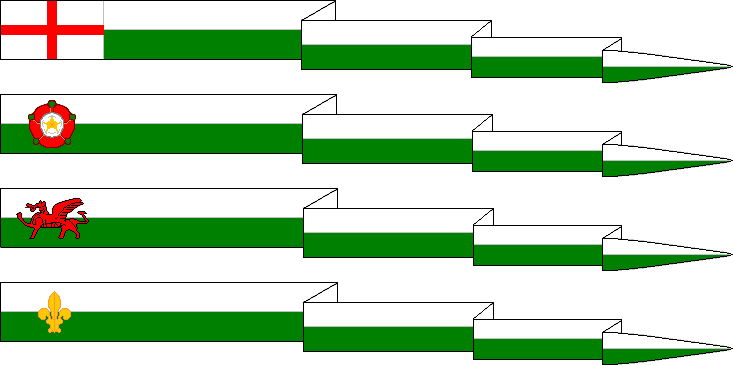
Masthead Pennants, 17th-18th Centuries

THE TUDOR NAVY

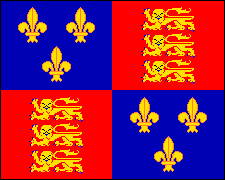
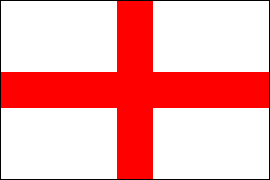
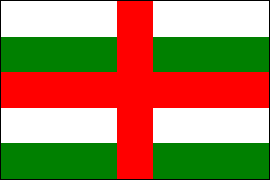
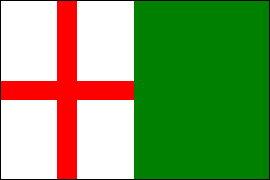
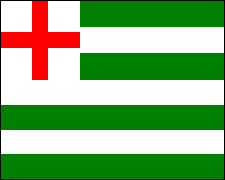
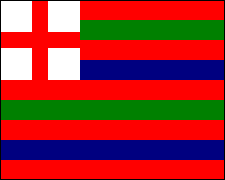
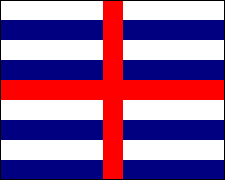
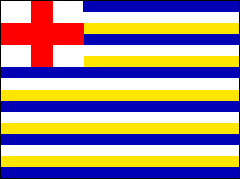
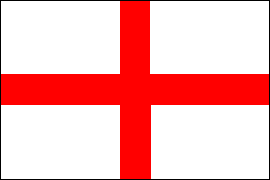
St. George was the patron saint of England, and the flag bearing his cross was the first "national" flag of England. During the reigns of Henry VIII and Elizabeth I, the Cross of St. George became the basic English naval flag. It also appeared as a canton in many of the striped ensigns of the latter's reign. These striped ensigns often featured green and white, the Tudor livery colors. When the monarch was present on board ship it was customary to fly the royal banner, and commanding admirals were sometimes permitted to fly it as a special mark of royal favor. The Tudor royal banner quartered the arms of France and England, reflecting the English monarch's claim to the French throne.

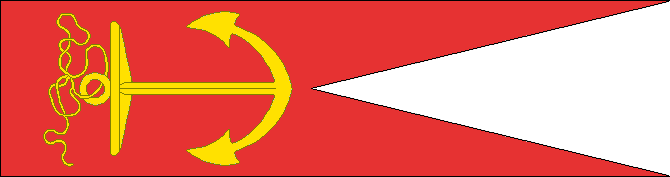
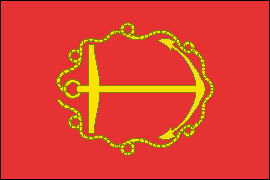
The earliest known version of the flag of the Lord High Admiral—a swallow-tailed crimson pennant bearing a golden anchor—dates from the reign of Henry VIII.


Left: Royal Banner, Sixteenth Century

Right: Cross of St. George. Ensign, Sixteenth Century; Foremast Flag, 1606-34; Jack, 1649


Typical Striped Ensigns, Sixteenth Century
 

Lord High Admiral, 16th Century
 

THE STUART NAVY

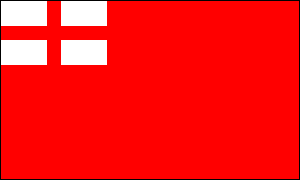
In the 1620's, striped ensigns began to give way to ensigns with solid-color fields and a canton of the Cross of St. George. By the middle of the seventeenth century there were three basic British naval flags: the Cross of St. George, the First Union Flag and the Red Ensign with the Cross of St. George as a canton. These flags formed the basis for all later British naval ensigns and jacks.

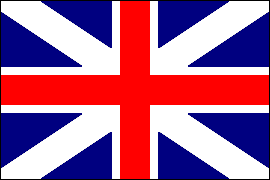
The First Union Flag appeared in 1606, when James VI of Scotland became King of England as James I. The Cross of St. George was combined with the Cross of St. Andrew (a white saltire cross on a blue field) to symbolize the union of England and Scotland under a single crown. This First Union Flag was specifically intended for use at sea and it was many years before it passed into use as a national flag on land.

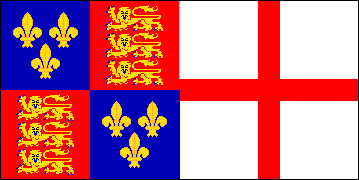
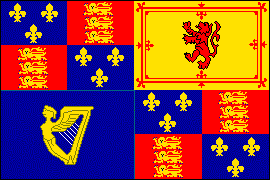
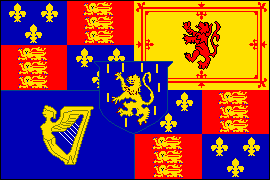
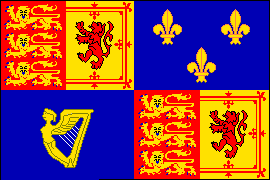
The royal banner of the Stuarts quartered the Tudor arms with those of Scotland and Ireland. When Prince William of Orange became King William III of England, an escutcheon of his arms were added to the royal banner. Throughout the seventeenth century, the royal banner was used both to signify the presence of the monarch and as a fleet commander's The Lord High Admiral's flag was now rectangular, with a different style of anchor.
 

First Union Flag. Mainmast Flag, 1606-34; Jack, 1634-39 and 1660-1801


Left: Royal Banner, 1603-89 and 1702-07     Right: Royal Banner, 1689-1702 (William III)
 

Lord High Admiral, 17th Century
 

THE THREE ENSIGNS

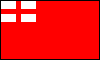
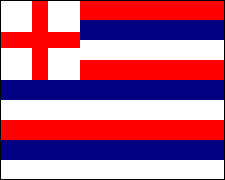
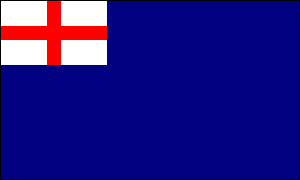
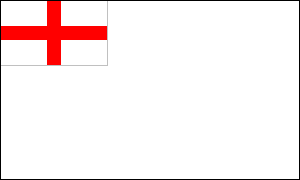
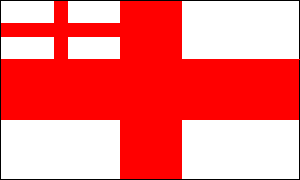
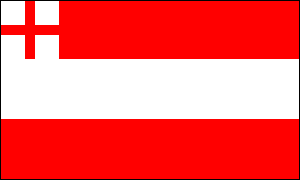
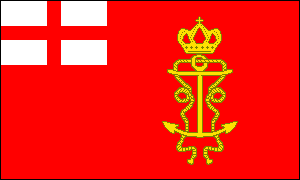
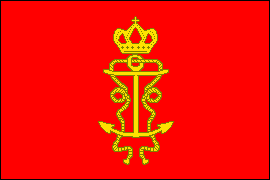
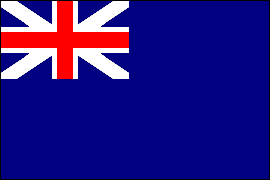
Blue and white ensigns were introduced in addition to the Red Ensign about 1625. Naval tactics were becoming more sophisticated at this time and the division of battle fleets into squadrons led to the introduction of distinctive squadron ensigns. This scheme survived, with variations, until 1864. Generally the Red Ensign was the senior color, but various changes were made over the years. In 1702, at a time when France was replacing the Dutch as England's principal naval rival, the White Ensign was modified by the addition of a broad Cross of St. George to distinguish it from the white ensigns of the French Navy. An ensign with horizontal red-white-red stripes and a small canton of the Cross of St. George was used briefly in 1702. As Lord High Admiral, James II flew a red ensign and a masthead flag bearing the insignia of that office.
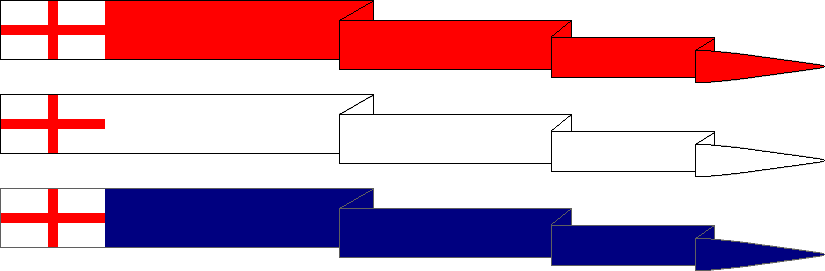
For each ensign there was a corresponding masthead pennant with the cross of St. George at the hoist. These pennants continued in use until the abolition of the three-ensign system in 1864, when the White Ensign and its corresponding pennant were prescribed for all commissioned ships of the Royal navy.


Left: Naval Ensign, (Red Squadron), 1620-1707     Right: Naval Ensign, (Blue Squadron), 1620-1707


Left: Naval Ensign (White Squadron), 1630-1702     Right: Naval Ensign (White Squadron), 1702-07
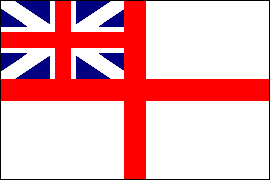
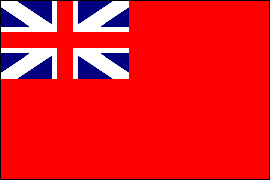
 

Naval Ensign, February-May 1702


Ensign (Left) and Masthead Flag (Right) of James II as Lord High Admiral (circa 1686)
 

Masthead Pennants, 17th-18th Centuries
 

THE NAVY OF THE COMMONWEALTH

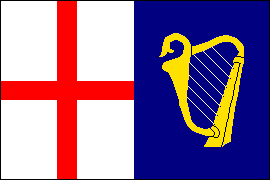
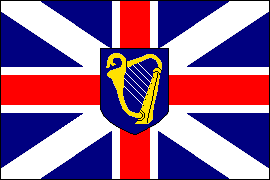
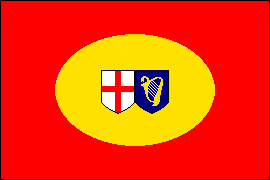
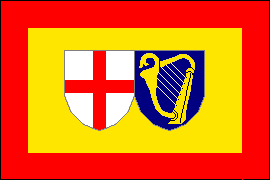
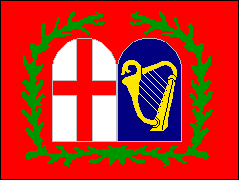
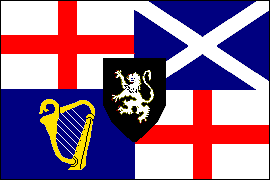
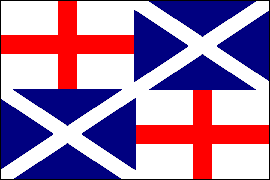
The English Civil War, the execution of Charles I and the rule of Oliver Cromwell as Lord Protector resulted in several changes to British naval flags after 1649, but they all continued to be based on the established national symbols: the crosses of SS. George and Andrew. At first it was proposed to restore the Cross of St. George as the naval ensign of the Commonwealth, but the three existing ensigns were retained instead. New jacks adding a harp for Ireland were introduced, and there were several types of command flags for admirals. The Lord Protector's personal banner was also used as a naval command flag. The Union Flag, which symbolized the united crowns of England and Scotland, was dropped after the abolition of the monarchy, but it reappeared as a naval jack in 1658 with an escutcheon of the arms of Ireland. In 1659, a new ensign quartering the crosses of SS. George and Andrew was adopted.  But with the Restoration of the monarchy in 1660, the Red, Blue and White ensigns, with the plain Union Flag, once more became the basic British naval flags.
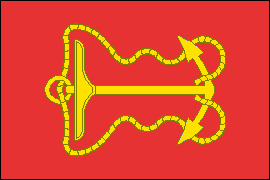



Left: Jack & Command Flag, 1649-58          Right: Jack: 1658-60


Left: Command Flag, circa 1652     Right: Lord Protector's Banner & Command Flag, 1658-59
              

Naval Ensign, 1659
 

THE NAVY OF THE KINGDOM OF GREAT BRITAIN

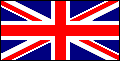
In 1707, new ensigns were established for the Royal Navy. All ships were ordered to fly the Union Flag as a jack and each squadron was given its own ensign displaying the First Union Flag in the canton. (In 1801 the diagonal red Cross of St. Patrick was added to the Union Flag.) These Red, Blue and White ensigns were used until 1864. In that year, the Union Jack and the White Ensign were reserved for the Royal Navy, the Blue Ensign was reserved for the use of qualified Royal Naval Reserve officers in command of merchant ships, and the Red Ensign became the British merchant ensign. All three are still in use today.

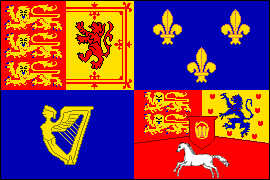
About 1700, the practice of using the royal banner as a command flag was abandoned. Thereafter, it was only flown at sea when the monarch was personally present. Queen Anne's royal banner displayed England impaled with Scotland in the first and fourth quarters, France in the second quarter, and Ireland in the third quarter. When the Elector George of Hanover assumed the British throne as King George I in 1714, the fourth quarter of the royal banner was altered to display his electoral arms.

Command flags for admirals of the three squadrons were white with the Cross of St. George, red and blue—hence the rank titles Vice-Admiral of the White, Rear-Admiral of the Red, etc. Exact rank was denoted by the mast from which the flag was flown: from the mizzenmast for a rear-admiral, from the foremast for a vice-admiral, and from the mainmast for an admiral.

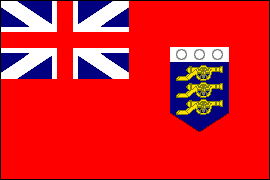
The Board of Ordnance was the government department responsible for the supply of weapons and munitions to the Army and Navy. Its vessels were permitted to fly a Red Ensign with the badge of the Board in the fly.

Some of the dates given with the drawings are approximate and it is likely that there were many deviations from the system described above. Commanding admirals, for example, often specified the flags to be flown by their fleets.


Left: Royal Banner, 1707-14 (Queen Anne)     Right: Royal Banner, 1714-1801 (House of Hanover)
 

Naval Ensign, White Squadron


Left: Naval Ensign, Red Squadron (The Meteor Flag)      Right: Naval Ensign, Blue Squadron
 

Lord High Admiral


Left: Jack & Admiral of the Fleet          Right: Admirals of the White Squadron


Left: Admirals of the Red Squadron           Right: Admirals of the Blue Squadron
 

Ensign, Board of Ordnance

BACK to UK Page