SCARLET POMP

COLORS OF THE BRITISH FOOT GUARDS

1747-1801

Images Added December 2006

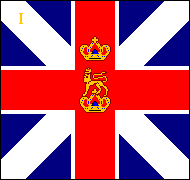
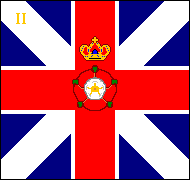
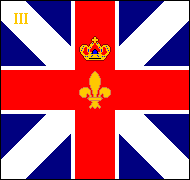
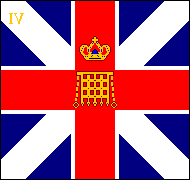
1st, 2nd, 7th & 25th Companies, 1st Foot Guards * 2nd (Coldstream) Foot Guards)

Notes

A regiment of foot guards, consisting of 12 companies, was raised by King Charles II in 1659, shortly before the 1660 Restoration. When Charles returned to England in 1660, his regiment of foot guards remained for the time being in Flanders. A second regiment of foot guards, also 12 companies strong, was raised in England, and in 1662 the two regiments were amalgamated to form the Royal or King's Regiment of Foot Guards, known during the eighteenth century as the 1st Regiment of Foot Guards, and since 1815 as the Grenadier Guards.

The Coldstream Guards originated as Monck's Regiment, having been raised by Colonel Monck in 1650 for Cromwell’s New Model Army. Monck and his regiment played a key role in the restoration of Charles II in 1660, marching from Coldstream in Scotland to London tin support of the returning king. In 1661 Charles made Monck's Regiment the unit second in seniority to the First Guards with the title "The Lord General's Regiment of Guards," this being Monck's new title. After Monck's death (1670), the regiment was renamed the Coldstream Guards. To this day the Coldstream Guards considers itself the senior guards regiment, as reflected by its motto Nulli Secundus ("Second to None").

The Third Regiment of Foot Guards or Scots Guards was raised during the Civil War, but until the Act of Union between England and Scotland (1707) it was part of the Scottish establishment. After the union of the two kingdoms, it became the third-ranking regiment of foot guards.

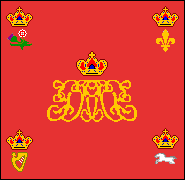
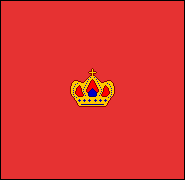
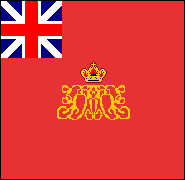
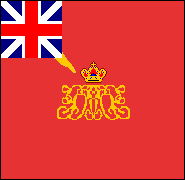
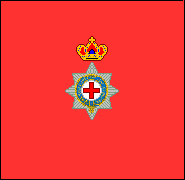
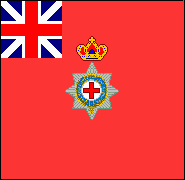
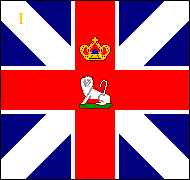
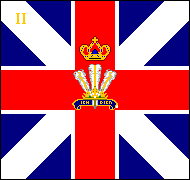
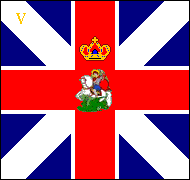
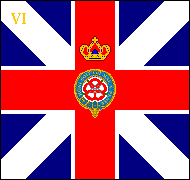
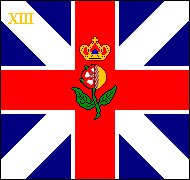
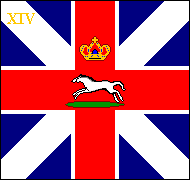
Each company of the Foot Guards regiments had its own color. Those of the Colonel, the Lieutenant-Colonel and the Major were crimson, while those of the remaining companies were Union Flags charged with company badges, crowns and numerals. When the system of company colors was abolished for the Army as a whole by the Royal Warrant of 1751, the Guards regiments were exempted. However, it was not the practice for all company colors to be taken on active service. A battalion of Guards employed either the Colonel's, the Lieutenant-Colonel's or the Major's Colour as the King's Colour, with one Company Colour employed as the Regimental Colour. Uniquely, the 1st Regiment of Foot Guards also had a Royal Standard: crimson, charged with the crowned Royal Cypher, and with crowned royal badges in the corners. How this standard was used is uncertain, but probably it was paraded only in the presence of the sovereign.

The colors shown below were in use up to 1800, when the Act of Union brought Ireland into the United Kingdom and led to a redesign of the Union Flag.

1st REGIMENT OF FOOT GUARDS


Royal Standard of the 1st Foot Guards


Left: Colonel's Company     Right: Lieutenant-Colonel's Company


Major's Company


Left: 1st (King's) Company         Right: 2nd Company


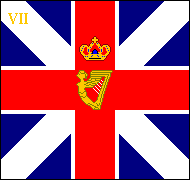
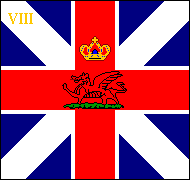
Left: 3rd Company     Center: 7th Company     Right: 8th Company


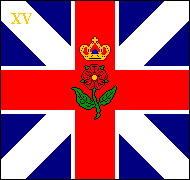
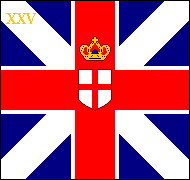
Left: 15th Company         Right: 25th Company

There were (and are) 24 badges for companies of the 1st Foot Guards, granted to the Regiment by King Charles II in 1661 (1-20) and by Queen Anne in 1713 (21-24).

2nd (COLDSTREAM) REGIMENT OF FOOT GUARDS


Colonel's Company


Left: Lieutenant- Colonel's Company     Right: Major's Company


Left: 1st Company     Center: 6th Company     Right: 14th Company

There were (and are) 15 badges for companies of the 2nd Foot Guards, granted to the Regiment by King William III in 1696 (1-9), King George I in 1716 (10-13) and King George II in 1729 (14-15).

BACK to UK Page