HIS MAJESTY'S FOOT

COLORS OF BRITISH FOOT REGIMENTS OF THE LINE

1751-1801

Image Added March 2007

17th Regiment of Foot (After 1777)

Notes

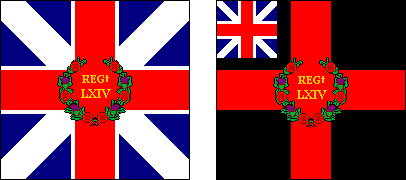
In 1751, a Royal Warrant introduced for the foot regiments of the line a two-color system that is still used nowadays by the British Army. Each regiment received a King's Colour, described as "the Grand Union throughout," and a Regimental Colour with a field in the regimental facing color and a canton of the Union Flag. Regiments whose facings were white or gray received a Regimental Colour with a white field quartered by a broad red cross. For regiments with black facings, the Regimental Colour was black, quartered by a broad red cross. On both colors, the number of the regiment, in gold Roman numerals, was to appear within a "union wreath" of roses and thistles. However, those regiments of the "Old Corps" with "ancient devices" or royal badges, such as the Royal Scots and the Buffs, were permitted to bear them on the colors, in which case the regimental number appeared in the upper hoist. The new colors were rectangular, being slightly longer on the fly than at the hoist. The artistic rendition of the wreath changed over time and since colors were only replaced when they wore out, different versions were generally in use at the same time. Occasionally the wreath from a worn-out color was salvaged and sewn onto a new one.

A few foot regiments of the line had two battalions, but most consisted of a single battalion with nine line companies and one grenadier company, for a total strength of about 800 officers and men. Grenadiers survived the demise of the hand grenade and came to be regarded as the army's elite shock troops. On active service, grenadier companies were usually detached from their parent regiments to form composite battalions. During the Seven Years War many regiments also raised a light infantry company, and these became a permanent part of the regimental structure in the early 1770's. Thus British foot regiments in the American Revolution consisted of eight line companies, one grenadier company and one light infantry company.

The British infantry of this period was noted for its steadiness and excellent fire discipline. The standard infantry weapon was the famous Brown Bess musket (officially the Long Land Pattern Musket and later in the century the Short Land Pattern Musket), perhaps the finest weapon of its type ever produced. With it, a well-trained soldier could load and fire three rounds per minute.

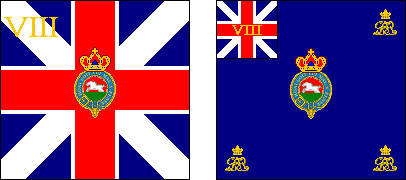
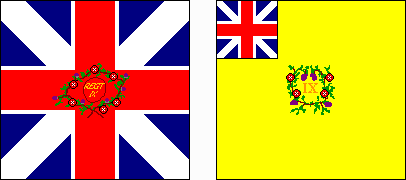
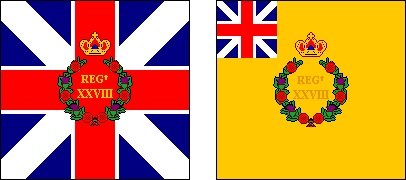
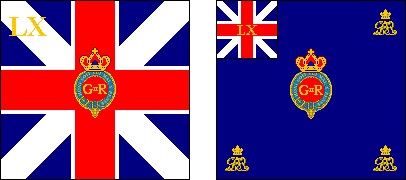
Left: King's Colour     Right: Regimental Colour


1st REGIMENT OF FOOT (THE ROYAL SCOTS)

As one of the Old Corps (in fact it was and is the oldest regiment in the British Army), The 1st Foot was entitled to bear special badges on its colors. The Royal Cipher of the monarch (here George II) appeared within a crowned Circle of St. Andrew. In three corners of the Regimental Colour was the floral badge of Scotland, a crowned thistle. The 1st Foot was a two-battalion regiment; the colors of the 2nd Battalion (illustrated) were distinguished from those of the 1st Battalion by the addition of a golden "stream blazant" issuing from the hoist or canton.


3rd REGIMENT OF FOOT (THE BUFFS)

Another famous Old Corps regiment, the Buffs bore the dragon badge of Wales on their colors. In three corners of the Regimental Colour was the floral badge of England, a crowned Tudor rose. The motto on the scroll over the dragon was Veteri Frondescet Honore. ("The glory of our fathers lives in us again.")


6th REGIMENT OF FOOT

As an Old Corps regiment, the 6th Foot bore its ancient badge, an antelope, on its colors. In three corners of the Regimental Colour was the floral badge of England, a crowned Tudor rose.


8th (KING'S) REGIMENT OF FOOT

As an Old Corps regiment, the 8th Foot bore a special badge on its colors: the white horse of Hanover within the Garter, under a royal crown. (Both George II and George III were also Elector of Hanover.) In three corners of the Regimental Colour was the crowned Royal Cipher.


9th REGIMENT OF FOOT

When the colors of the 9th Foot were renewed in 1772, the wreath from an earlier stand was salvaged for the new Regimental Colour. The King's Color, however, was completely new.


15th REGIMENT OF FOOT


17th REGIMENT OF FOOT

Left: Colors Prior to 1777                    Right: Colors After 1777

During the American Revolution, the 17th Foot saw considerable service in New York and Pennsylvania (1776-77), particularly distinguishing itself at the Battle of Princeton (3 January 1777). For this action the regiment was permitted to bear on its colors a laurel wreath enclosing the regimental number. The 17th Foot was part of the British army that surrendered at Yorktown, Virginia (October 1781), effectively bringing the Revolution to a close.


27th (INNISKILLING) REGIMENT OF FOOT

Raised in 1689 as Zacharaiah Tiffin's Regiment of Foot to defend the Irish town of Inniskilling, this regiment was transferred to the English establishment in 1690 and numbered as the 27th Foot in 1751. Its origins qualified the 27th as an Old Corps regiment; its special badge was a three-towered castle flying the Cross of St. George, in commemoration of the defense of Inniskilling.


28th REGIMENT OF FOOT

55th REGIMENT OF FOOT

60th (ROYAL AMERICAN) REGIMENT OF FOOT

The 60th Foot was raised in 1755 as a regiment of four battalions for service in North America. Its original recruits came mainly from Germany, and from the Swiss and German settlers of Pennsylvania and Maryland. Initially it was designated as the 62nd Foot, being renumbered and titled "Royal American" in 1757, after the disbandment of the 50th and 51st Foot. In its early years the 60th Foot had something of the flavor of a foreign legion, its ranks being filled with American colonists, Irishmen, Germans, Poles, Bohemians, French prisoners of war, and deserters from other British regiments. The regiment served in the American Revolution and went on to great glory in later wars as the 60th Rifles (King's Royal Rifle Corps).


64th REGIMENT OF FOOT

The British Grenadiers

Some talk of Alexander
And some of Hercules
Of Hector and Lysander
And such great names as these.
But of all the world's brave heroes
There's none that can compare
With a tow-row-row-row-row to
The British Grenadiers!

Those heroes of antiquity
Ne'er faced a cannon ball
Nor knew the use of powder
To slay their foes withal.
But our brave boys do know it
And banish all their fears.
Sing tow-row-row-row-row for
The British Grenadiers!

 Whene'er we are commanded
To storm the palisades
Our leaders march with fusils
And we with hand grenades.
We throw them from the glacis
About the enemy's ears.
Sing tow-row-row-row-row for
The British Grenadiers!

 Then let us fill a bumper
And drink a health to those
Who carry caps and pouches
And wear the louped clothes.
May they and their commanders
Live happily all their years.
With a tow-row-row-row-row for
The British Grenadiers!

BACK to UK Page