THE YANKEE DIVISION
FLAGS & GUIDONS OF THE 26th DIVISION, MASSACHUSETTS ARMY NATIONAL GUARD
1931 Regulations
The interwar US Army's basic tactical formation was the infantry division. Organizationally, the division had changed little since World War I: It was still a "square" division with two infantry brigades each controlling two infantry regiments and an artillery brigade controlling three field artillery regiments. With a total of twelve infantry battalions and six field artillery battalions, the square division was a powerful but somewhat unwieldy unit.
Infantry regiments consisted of a regimental headquarters company, three infantry battalions, a regimental cannon company, a regimental machinegun company and a regimental service company. Field artillery regiments consisted of a regimental headquarters company, two field artillery battalions, an observation battery and a regimental service battery. The division train was responsible for supply and transportation, and the field artillery brigade had its own ammunition train.
National Guard divisions did not receive the type designator "infantry" until 1940-41, when they were inducted into Federal service. Thus the Yankee Division was simply the 26th Division.
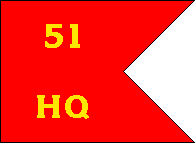
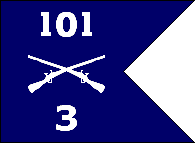
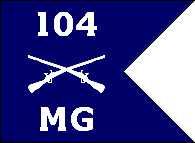
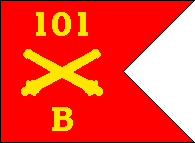
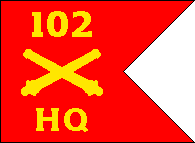
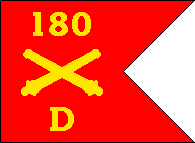
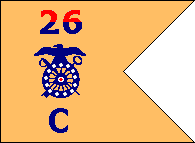
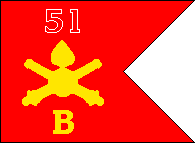
Distinguishing flags for Army organizations not authorized to bear colors were made of wool bunting; dimensions were 3 feet at the hoist by 4 feet on the fly. For infantry divisions the flag was horizontally divided, scarlet over national flag blue, with the authorized shoulder sleeve insignia centered. The distinguishing flag was always carried or displayed with a National Standard, Service of the same material and dimensions (plus 2 1/2-inch silk fringe). Guidons for headquarters elements of divisions were of the same design as the corresponding distinguishing flags. Company, battery and troop guidons of regiments and battalions were much the same as those in use nowadays; they were made of cotton or wool bunting, 20 inches at the hoist by 27 inches on the fly with a 10-inch fork.
Credit: The drawings on this page are based on the specifications given in Army Regulation 260-10 dated 10 June 1933, a copy of which was kindly provided by FOTW Mailing List member Joseph McMillan.