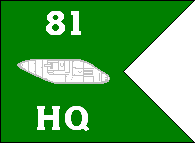
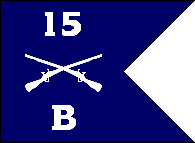
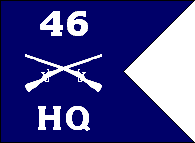
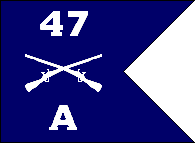
VICTORY DIVISION
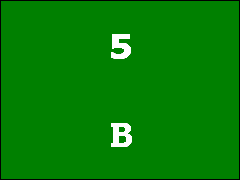
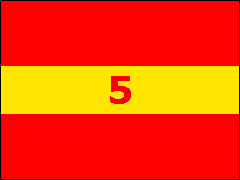
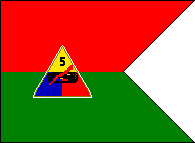
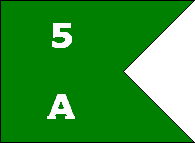
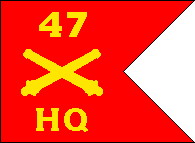
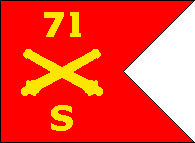
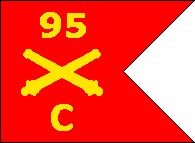
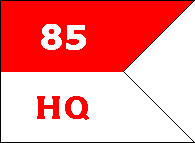
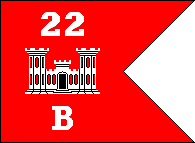
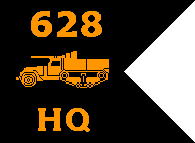
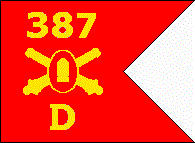
5th ARMORED DIVISION FLAGS & GUIDONS
1944 Regulations
Image Added November 2003
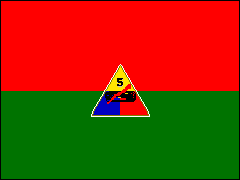
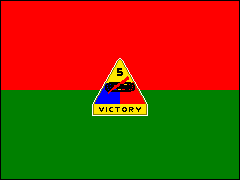
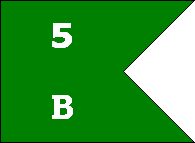
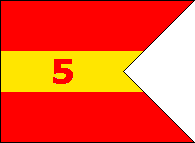
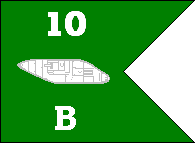
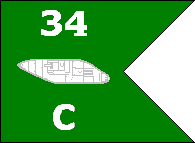
Distinguishing Flag, 5th Armored Division (official design with no SSI tab)
By DS-Day, most US Army armored divisions had been reconfigured under the "light" Table of Organization and Equipment (TOE) introduced in 1943. The previous organization, with two armored regiments (four medium and two light tank battalions) and one armored infantry regiment (three battalions) had proved to be too large and too tank heavy, though two armored divisions (2nd and 3rd) remained in this configuration until the end of the war.
The 1943 armored division contained three tank battalions (each with one light and three medium tank companies), three armored infantry battalions, three self-propelled field artillery battalions, a mechanized cavalry squadron and various support units. Regimental headquarters were abolished in favor of two combat command headquarters to which the combat battalions and other division assets could be attached as required. These headquarters were designated Combat Command A (CCA) and Combat Command B (CCB). In 1944, a small "reserve" combat command headquarters (CCR) was also authorized. The personnel for this new headquarters mostly were provided by the HQ elements of redundant tank, armored or tank destroyer groups. There were also headquarters units for the division artillery and the division trains (logistical support units).
Each tank battalion contained 53 M4 Sherman medium tanks (75mm gun) in three companies, 17 M5 Stuart light tanks (37mm gun) in one company, and a support platoon with six Sherman tanks mounting a 105mm howitzer. The armored infantry battalions were equipped with the M3 halftrack, each of which could carry a rifle squad. The armored field artillery battalions each contained 18 self-propelled 105mm howitzers. The mechanized cavalry squadron was equipped with wheeled armored cars, light tanks and halftracks. In all, the division contained 10,610 officers and enlisted personnel.
Armored divisions were often reinforced with attached units, typically a self-propelled tank destroyer battalion and a self-propelled antiaircraft artillery battalion. The former was equipped with either the M10 (3-inch gun) or the M18 (76mm gun) self-propelled tank destroyer. (Late in the war, a few battalions received the M36 tank destroyer with a 90mm gun.) The AAA battalion was usually a self-propelled automatic weapons-type unit with 37mm guns and quadruple .50-caliber machineguns mounted on halftracks. With these attachments, the armored division was capable of generating an enormous volume of firepower. The attached AAA battalion proved particularly effective in its secondary ground fire support role.
The 5th Armored Division ("Victory") was activated in October 1941 at Fort Knox, Kentucky, arrived in the United Kingdom in February 1944 and landed in France on 25 July 1944. The division participated in the following campaigns: Normandy, Northern France, Rhineland, Adrennes-Alsace and Central Europe. In total, 710 soldiers of the 5th Armored Division and its attached units were killed in action or died of wounds received in action, and 2,442 were wounded in action. The division returned to the United States in October 1945 and was inactivated at Camp Kilmer, New Jersey, on 11 October 1945.
Credits: The drawings on this page are based on the specifications given in Army Regulation 260-10 dated 25 October 1944, a copy of which was kindly provided by FOTW Mailing List member Joseph McMillan. To learn more about the history of the 5th Armored Division, visit 5AD ON LINE, hosted by Rick Stilly.
Historical Footnote: The 66th and final annual reunion of the 5th Armored Division Association was held on 14-17 June 2012 in Bangor, Maine, with fifteen former members of the division and more than 300 friends and family in attendance. The closing address was given by Colonel George C. Benjamin, United States Army (Retired), who commanded the division's 85th Cavalry Reconnaissance Squadron. Lest we forget.