UNITED STATES ARMY AIR FORCES
 

icon78.gif (428 bytes)
 

DISTINGUISHING FLAGS & GUIDONS  •  SEVENTH AIR FORCE  •  WORLD WAR II

 

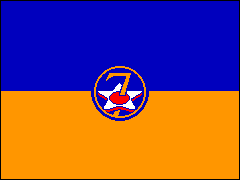
The Seventh Air Force was (and remains) the oldest numbered air force of the United States Army Air Forces and the United States Air Force. It was originally constituted as the Hawaiian Air Force and activated as such on 1 November 1940. In February 1942 it was redesgnated as the Seventh Air Force. Originally responsible for the air defense of the Territory of Hawaii, the Seventh Air Force later served in the central and western Pacific areas. Throughout the war, however, elements of the Seventh remained stationed in Hawaii with the missions of air defense and logistical support.
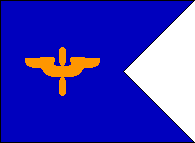
The Seventh Air Force was organized with the VII Fighter Command (P-38, P-47 and P-51 fighters), the VII Bomber Command (B-17 and B-24 heavy bombers; B-25 medium bombers) and the VII Service Command. Various other seperate squadrons were assigned to air force headquarters and attached as necessary to the commands. The two separate reconniassance squadrons were equipped with the F-5 (reconnaissance version of the P-38 fighter). The separate liaison squadron flew the L-5. Sentinal. The 419th Troop Carrier Group had no subordinate squadrons or aircraft assigned; the group headquarters was tasked with coordination and management of air transport in the Seventh Air Force area of operations. All units down to the group level had a headquarters squadron (HHS). Because of the highly technical nature of air operations there were many specialized service and support units difficult to categorize. Such units probably had the guidon shown below for "other aviation detachments" with the Air Corps branch insignia but no other markings. Also, many of the service and support units were split into detachments.
In 1926 the Air Service was made an Army branch and was renamed the US Army Air Corps (USAAC). The group became the color-bearing echelon of the USAAC. Group organizational standards were of the usual Army pattern: made of silk, 3 feet at the hoist by 4 feet on the fly, with ultramarine blue field, golden orange fringe and the group coat of arms above a designation scroll. The Chief of the Air Corps and other general officers on the USAAC staff were authorized field and boat flags. They were 3 feet at the hoist by 4 feet 9 inches on the fly, with the branch insignia in golden orange and white stars according to rank. For the Chief of the Air Corps and other major generals on the staff, the stars flanked the branch insignia; for brigadier generals on the staff, one star was placed above the insignia. Generals not on the USAAC staff used the standard Army rank flags.
Credit: The drawings on this page are based on the specifications given in Army Regulation 260-10 dated 8 February 1923, a copy of which was kindly provided by FOTW Mailing List member Joseph McMillan.


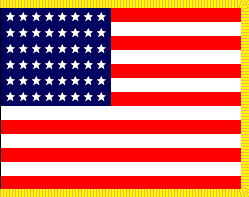
NATIONAL STANDARD, SERVICE & DISTINGUISHING FLAGS


SEVENTH AIR FORCE


VII FIGHTER COMMAND


VII BOMBER COMMAND


VII SERVICE COMMAND


HEADQUARTERS ELEMENT GUIDONS


DIRECT REPORTING UNITS


419th TROOP CARRIER GROUP (GROUP HEADQUARTERS ONLY)


9th TROOP CARRIER SQUADRON (SEPARATE) (C-46 & C-47)


163rd LIAISON SQUADRON (SEPARATE) (L-5)


28th PHOTO RECON SQUADRON (SEPARATE) (F-5)


41st PHOTO RECON SQUADRON (SEPARATE) (F-5)


OTHER AVIATION DETACHMENTS


BACK to US AIR FORCE Page