![]()
![]()
"HAT in the RING"
![]()
US Army Air Service & US Army Air Corps
Flags, Colors & Guidons
1923 & 1931 Regulations
![]()
Notes
In the early 1920's the US Army Air Service lacked the elaborate organization now associated with air forces. Air Service units were attached to higher headquarters of the Army, such as corps, which included an air operations section. Thus the highest "pure" Air Service units were squadrons and companies.
Aero squadrons operated all types of aircraft, from fighters to observation planes, while airship companies provided the crews for Army-operated lighter-than-air craft. Airdrome companies were airfield housekeeping units and service squadrons were responsible for maintenance and supply. Balloon companies and balloon service companies operated and maintained captive observation balloons of the type widely used for artillery spotting during World War I.
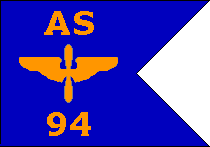
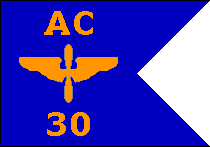
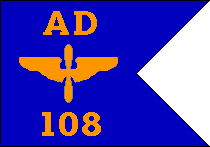
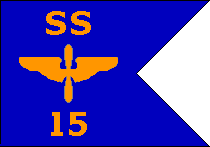
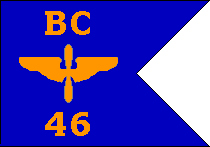
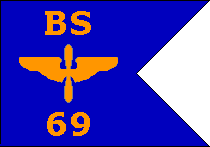
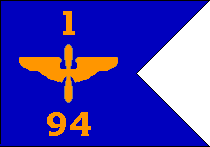
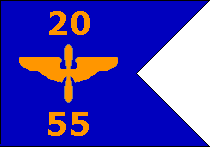
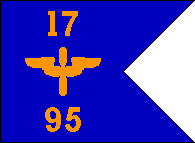
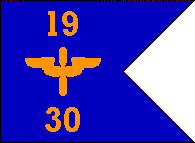
The branch colors of the Air Service were ultramarine blue and golden orange and its insignia was the winged propeller badge introduced during World War I. Like all Army guidons of the period, those of the Air Service were made of wool bunting in dimensions of 2 feet 3 inches at the hoist by 3 feet 5 inches on the fly with a 15-inch fork. In 1924, the aero squadrons were organized into groups, and squadron guidons were modified to show the group's numerical designation above the branch insignia. The 1931 regulations reduced the dimensions of Army guidons to 1 foot 8 inches at the hoist by 2 feet 2 3/4 inches on the fly. The Air Corps guidon design thus established remained unchanged until 1947, when the Air Force became a separate armed service.
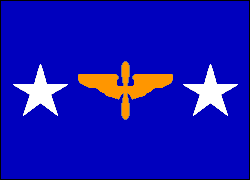
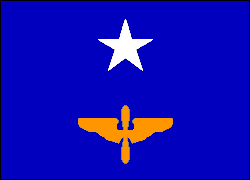
In 1926 the Air Service was reorganized as an Army branch, and was renamed the US Army Air Corps (USAAC). The group became the color-bearing echelon of the USAAC. Group organizational standards were of the usual Army pattern: made of silk, 3 feet at the hoist by 4 feet on the fly, with ultramarine blue field, golden orange fringe and the group coat of arms above a designation scroll. The Chief of the Air Corps and other general officers on the USAAC staff were authorized field and boat flags They were 3 feet at the hoist by 4 feet 9 inches on the fly, with the branch insignia in golden orange and white stars according to rank. For the Chief of the Air Corps and other major generals on the staff, the stars flanked the branch insignia; for brigadier generals on the staff, one star was placed above the insignia. Generals not on the USAAC staff used the standard Army rank flags.
Credit: The drawings on this page are based on the specifications given in Army Regulation 260-10 dated 8 February 1923, a copy of which was kindly provided by FOTW Mailing List member Joseph McMillan.
![]()
1923-24 GUIDONS

94th AERO SQUADRON
This was the famous "Hat in the Ring
Squadron" of World
War One
. . . . . . . . . .
Left: 30th AIRSHIP COMPANY
Right: 108th AIRDROME
COMPANY

15th SERVICE SQUADRON
. . . . . . . . . .
Left: 46TH BALLOON COMPANY
Right: 69th BALLOON
SERVICE COMPANY
1924-31 GUIDONS
. . . . . . . . . .
Left: 94th PURSUIT SQUADRON, 1st PURSUIT GROUP
Right: 55th PURSUIT
SQUADRON, 20th PURSUIT GROUP
1931-47 GUIDONS
. . . . . . . . . .
Left: 95th ATTACK SQUADRON, 17th ATTACK GROUP
Right: 30th
BOMBARDMENT SQUADRON, 19th BOMBARDMENT GROUP
INDIVIDUAL
FLAGS

FIELD & BOAT FLAG, CHIEF OF THE AIR CORPS
![]()
BACK to US AIR FORCE Page