![]()
![]()
REDLEGS & COSMOLINERS
![]()
US Army Field Artillery & Coast Artillery Corps
Flags & Guidons
1931 Regulations
Image Added August 2004
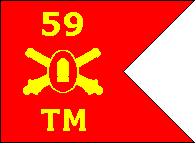
Guidon, Trench Mortar Battery, 59th Coast Artillery

![]()
Notes
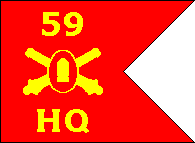
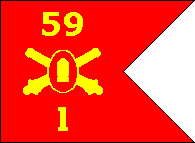
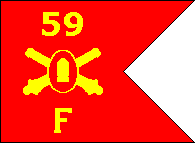
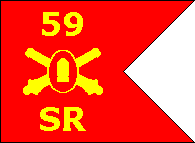
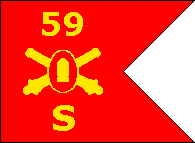
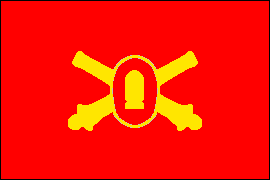
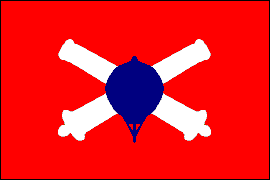
The flags and guidons of the interwar US Army's artillery branches were similar to those used today. The two artillery branches, Field Artillery (FA) and the Coast Artillery Corps (CA), both used scarlet and yellow as branch colors. The FA had yellow crossed cannons as its branch badge while the CA had a scarlet oval, edged yellow and bearing a yellow projectile, over yellow crossed cannons. (The same badges, made in gilt or brass, were worn on the uniform.)
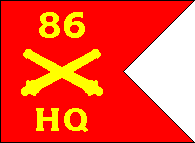
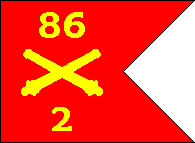
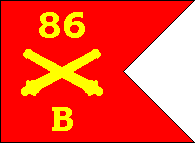
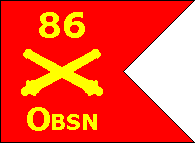
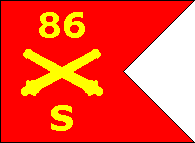
Battery guidons displayed the regimental number above and the battery designation below the branch badge. Battalion designations appeared only on guidons of headquarters batteries of battalions; firing batteries were lettered in sequence regardless of the battalion to which they were assigned. Dimensions for guidons were 20 inches at the hoist by 27 3/4 inches on the fly with a 10-inch fork, and they were made of wool bunting.
In theory, an FA regiment consisted of a regimental headquarters battery, two battalion headquarters batteries, six firing batteries, an observation battery and a service battery. The regiment's first battalion generally controlled the firing batteries lettered A, B and C, while the second battalion controlled those lettered D, E and F. Three such regiments, under the control of an FA Brigade, constituted the artillery component of an infantry division. Many FA regiments and brigades, however, were maintained at reduced strength in the 1930's, e.g. with only three firing batteries and no battalion headquarters batteries.
CA regiments were divided into four types: harbor defense, railway, mobile, and mobile antiaircraft. The last three had fairly standard organizations, but harbor defense regiments were tailored to the requirements of specific harbor defense organizations and could contain as many as twelve batteries armed with several types of weapons.
Each branch had a Chief, usually a major general, who was responsible for training, organization and branch-specific combat doctrine development. Distinctive field and boat flags were authorized for these officers. Commanders of Harbor Defense organizations, e.g. Harbor Defenses of Boston, were also authorized a distinctive boat flag.
The US Army Mine Planter Service was a component of the overall coastal and harbor defense force. A distinguishing flag, to be flown at the bow when underway, was authorized for its vessels.
"Redlegs" is a traditional nickname for the Field Artillery, derived from the red trouser stripes of Civil War artillerymen. The Coast Artillery's nickname, "Cosmoliners," derived from the preservative grease used to protect coastal guns from the corrosive effects of salt air and spray. During World War II, the Coast Artillery saw little action in its traditional role, but CA units formed the nucleus of the Army's antiaircraft artillery force. Thus the "Cosmoliners" can be considered the ancestors of the Army's modern Air Defense Artillery branch.
Credit: The drawings on this page are based on the specifications given in Army Regulation 260-10 dated 20 November 1931, a copy of which was kindly provided by FOTW Mailing List member Joseph McMillan. The drawing of the flag for US Army Mine Planter Service vessels is based on an image posted to the FOTW Mailing List by Mr. McMillan.
![]()
86th FIELD ARTILLERY (PHILIPPINE SCOUTS)

Regimental Headquarters Battery
. . . . . . . .
Left: Headquarters Battery, 2nd Battalion
Right:
Battery B
. . . . . . . . . .
Left: Observation Battery
Right: Service Battery
59th COAST ARTILLERY (HARBOR DEFENSE)

Regimental Headquarters Battery
. . . . . . . . . .
Left: Headquarters Battery, 1st Battalion
Right:
Battery F

Trench Mortar Battery
. . . . . . . . .
.
Left: Sound Ranging Battery
Right: Service Battery
HARBOR DEFENSE COMMANDER

BOAT & LAUNCH FLAG
MINE PLANTER
SERVICE

VESSEL FLAG
![]()
BACK to US ARMY Page